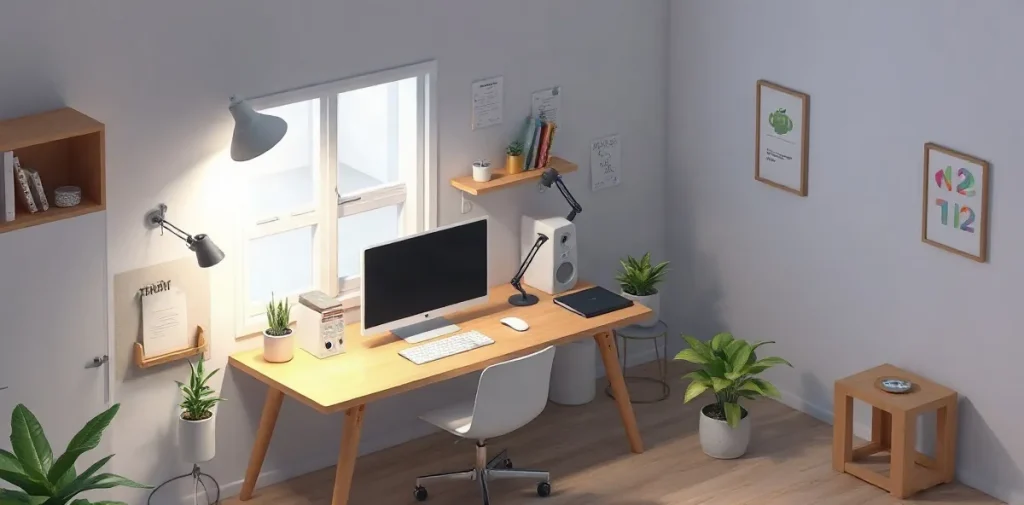
Technology is useful at home when it solves a specific problem without complicating familiar tasks. Choose devices and apps to meet your needs, not for features you will never use.
Start with everyday frustrations: extra steps, forgotten tasks, or household processes you would like to simplify. This makes it easier to understand which technology will actually help, how much time or effort it will save, and whether it fits your lifestyle.
| Stage | What is done | What is checked |
|---|---|---|
| Technical design | A prototype and user profiles are created | Whether the functionality matches the use case |
| Project implementation | Software modules are refined, servers and software are configured | How the system components work |
| Debugging and testing | A comprehensive check is carried out | Whether the household task is completed |
| Deployment and operation | The system is put into use and maintained | Its usefulness and need for support |
- 10 years The period during which the phenomenon of big data was the subject of numerous studies, as stated in the article’s introduction.
- 2023; 30(2): 5–22 The year, volume, issue, and pages of a publication on big data in official statistics.
- 5–22 The pages of the article in the journal Voprosy Statistiki.
How do you choose a household problem for technology to solve?
Start with the use case, not the device
Choose a household problem for technology based on a recurring frustration: for example, having to check an appliance’s status manually or repeat the same setup every time. First, write down the use case without tying it to a gadget: who takes the action, when they do it, and what should change once the technology is in place.
For a use case involving an appliance check, specify who checks its status and when that check is needed; the desired change is to get clear information without checking manually. For repeated setup, describe who sets the parameters and in what situation, then decide which part of the process could be simplified. This analysis helps distinguish a problem to solve from the idea of buying a device.
When designing applications, a system prototype and user profiles help clarify the functionality. This approach is part of technical design: for example, a user profile shows which actions need to be provided for a particular use case. Alexander Evgenyevich Surinov is associated with the National Research University Higher School of Economics (HSE University), Moscow.
- Essential feature: the ability to check a device’s status without going around to inspect it manually, or to reset a required parameter.
- Nice to have: additional features that do not affect solving the original problem.
- Measure of usefulness: define in advance which action should become easier or clearer, or require fewer manual steps; after implementation, compare it with the original use case.
What should you include in the requirements and prototype?
For the requirements and prototype of household technology, record the system’s purpose, the user profile, and their key actions, then check each feature against the chosen use case. During technical design, a system prototype and user profiles are created; clarifying the functionality should reduce uncertainty, not expand the list of features.
User profile
For each household use case, describe who uses the solution and exactly what they do. For example, for lighting control, record the input—the user’s command—the expected action—turning on the light—and a clear result: the user can see that the light has come on.
First-version boundaries
Keep only the features needed to test the use case in the prototype: that way, changes after the first test won’t require reworking the whole project. This is especially important while the user’s actions and the system’s response are still being clarified.
- Include: the input, the system’s action, and how the result is shown.
- Defer: features that do not help test the chosen use case.
For reference on technical design: an article on big data in official statistics was published in 2023 in the journal Voprosy Statistiki, volume 30, issue 2, pages 5–22.
How do you go from a prototype to a working system?
To turn a prototype into a working system, refine the software modules in sequence, configure the servers and software, then test the system as a whole and prepare it for operation. Successfully launching one feature confirms only that it works—not that the other components are ready.
From implementation to testing
A prototype helps test an idea and clarify the functionality; software modules put that functionality into the product. After the design stage, identify which modules need further work, and separately record the server and software settings required for the system to run.
Configuring servers and software is a separate part of implementation, not a continuation of prototype testing. Afterward, carry out comprehensive debugging: check how the modules interact and how the system works as a whole. For example, if an individual feature launches, that does not prove it exchanges data correctly with other components.
Plan deployment as a sequence of three stages: implementation, testing, and ongoing operation. First assemble the system from the refined modules and configured infrastructure, then test it comprehensively; only after that should you begin using it at home. This separation helps prevent a successful launch of one feature from being mistaken for a product that is ready for use.
How can you tell whether technology really makes life easier?
The only way to check whether household technology makes life easier is to test it against the original problem: the user should carry out the use case the prototype was created for, and the result should be compared with how they managed without it. For example, with a lighting control system, test whether it turns on the required lights—not just whether the app launches.
Testing in real-world use
Compare the use case before and after implementation using observable signs. Note how many manual actions the task requires, whether the system needs to be set up again, and whether the user understands what has happened. These criteria apply both to a household app and to automation that controls devices.
- Manual actions: does the user still have to switch on the appliance separately or perform steps the technology was meant to handle?
- Repeated setup: are the selected settings saved after the use case is completed, or do they have to be entered again?
- Clarity of the result: can the user tell whether the task is complete without guessing from the device’s status?
Don’t just check whether the system launches successfully: deliberately enter incorrect data or interrupt the use case, then see how the system reports the error and lets the user continue. Comprehensive debugging of software modules, server settings, and software helps uncover failures; after testing, refine the functionality by removing anything unnecessary and improving whatever gets in the way of the main task.
When is automation not worth the effort?
Automation is not worth the effort if a household task happens rarely and takes little time: setting up and maintaining a system may take more effort than it saves. For example, creating a separate app routine for a one-off light switch adds steps—setup, testing, and possible troubleshooting.
The cost of ongoing support
Standard technology implementation aims to reduce transaction costs and the time needed to carry out processes, including programming, testing, and user training. But you need to consider the entire cycle: once the system is assembled, server and software configuration, debugging, and training still remain—and these will need to be factored in during ongoing use, too.
An unclear process should be organized before it is automated: a prototype can lock in confusion if the sequence of actions and users’ roles have not been defined. For a household use case, check three criteria:
- Frequency: a rare task is easier to do manually than to maintain a separate system for.
- Process: before building a prototype, write down the steps and establish who is responsible for each one.
- Ongoing support: weigh the time saved against software configuration, debugging, and training after launch.
How can data help you test a prototype?
Data as a supporting tool
Data can help test a prototype if you record only the observations needed for a particular household use case: whether the person managed to complete the task and where they stopped. For example, when testing a prototype app for controlling household appliances, it is enough to record whether the specified action was completed and where the user ran into difficulty—there is no need to collect information unrelated to the test.
Big data does not replace prototype testing: its use in official statistics is considered separately from assessing whether a user can complete a task in a particular interface. An article on the subject was published in 2023 in the journal Voprosy Statistiki: volume 30, issue 2, pages 5–22; it is associated with Alexander Evgenyevich Surinov of the National Research University Higher School of Economics (HSE University), Moscow.
- To test a use case: record whether the task was completed and where the user stopped.
- For big data: treat it as a separate tool for official statistics, not as a ready-made replacement for observing a prototype in use.
Frequently asked questions
Where should I start if I have an idea for a household device?
What should happen after the prototype is built?
How can I tell whether a prototype is useful?
Why shouldn’t I add lots of features right away?
Sources
- ibeks.ee — “ERP solution”
- toplink.ee — “A FRAMEWORK FOR MARKETING MANAGEMENT — Toplink”
- inm.ras.ru — “Tensor methods for solving multidimensional partial”
- taskee.pro — “5 steps to automating tasks in software development — Taskee”
- ibm.com — “[PDF] IBM SPSS Statistics V27 — Quick Start Guide”