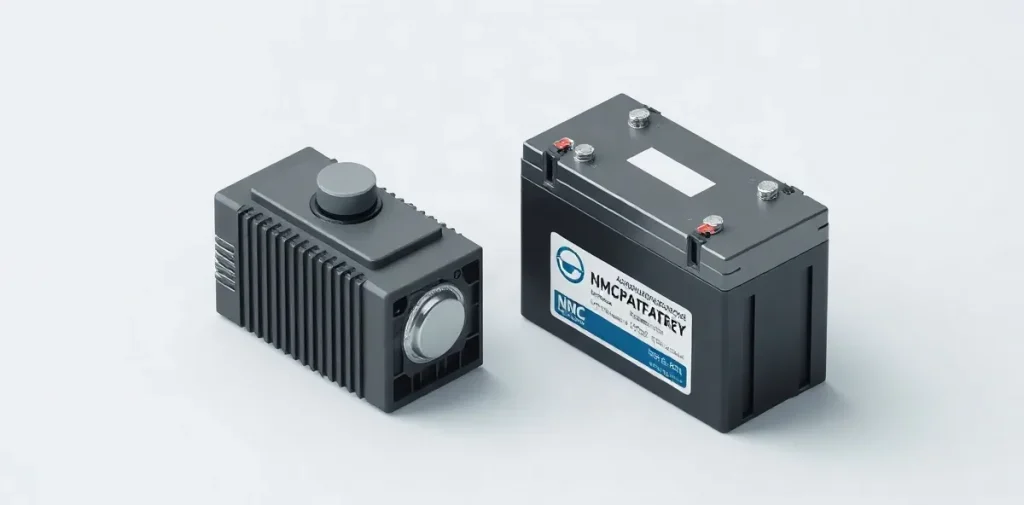
LFP batteries generally offer longer cycle life and greater thermal stability, while NMC batteries have higher energy density; price depends on the specific battery and operating conditions. There is no universally best chemistry: the choice depends on what matters most—service life, driving range, or cost.
In “LFP vs. NMC: Lifespan, Safety, and Cost,” we’ll look at how these lithium-ion batteries differ and how those differences play out in practice. It’s worth comparing not only cycle life and the risk of overheating, but also the specifications of the specific model: the same chemistry alone does not guarantee the same results.
| Criterion | LFP | NMC |
|---|---|---|
| Chemistry | Lithium iron phosphate | Nickel, manganese, and cobalt |
| Energy density | Lower than NMC | 150–220 Wh/kg according to bonnenbatteries.com |
| Nominal cell voltage | About 3.2 V | About 3.6–3.7 V |
| Cycle life | 2,500–5,000 cycles according to Large Battery | No comparable range provided |
| Best suited to | Long cycle life for stationary storage | High energy density for electric vehicles |
- 150–220 Wh/kg Typical energy density of NMC cells
- 2,500–5,000 cycles LiFePO4 cycle life
- 10–15 years LiFePO4 service life
- 60–70% NMC capacity at –20 °C relative to its capacity at room temperature
- from US$2,227 to US$11,000 Price of a 48 V 200 Ah lithium battery according to BSLBATT
How do LFP and NMC differ in chemistry and energy density?
LFP is a lithium iron phosphate battery, while NMC batteries have a cathode made of nickel, manganese, and cobalt. The difference in chemistry is also reflected in energy density: NMC typically stores more energy per unit of mass.
- NMC: Typical energy density is 150–220 Wh/kg, according to bonnenbatteries.com. At the same battery weight, higher density allows it to store more energy.
- LFP: Its chemistry includes lithium, iron, and phosphate. The nominal cell voltage is about 3.2 V.
- NMC: The nominal cell voltage is about 3.6–3.7 V.
What the difference means for a battery
Cell voltage is not the same as the energy capacity of the entire battery: capacity and battery-pack design also affect it. So it’s not accurate to compare specific batteries based only on nominal voltage.
If storing more energy at a given weight is the priority, NMC has the advantage in energy density. When choosing a specific battery, compare its specifications as a whole, not just its chemistry.
Why choose NMC for an electric vehicle and LFP for stationary storage?
NMC is more often chosen for electric vehicles, where driving range matters and battery weight and volume are limited; LFP is chosen for stationary storage, where weight is usually less critical and long cycle life matters.
NMC cells typically have an energy density of 150–220 Wh/kg. Higher density makes it possible to fit a battery with greater energy capacity in a car without a corresponding increase in weight and volume.
- NMC for electric vehicles: High energy density supports a long driving range when battery size and weight are limited.
- LFP for home storage: With a stationary installation, weight is usually less important, so long cycle life becomes an advantage.
- LFP cell voltage: Nominal voltage is about 3.2 V, while the full-charge voltage is 3.6 V.
Compare complete batteries
Cell chemistry alone does not determine the capacity, power, or price of a specific system. These parameters depend on the battery as a whole, so when choosing a car or home storage system, compare complete solutions rather than NMC and LFP alone.
How do you compare cycle life and service life?
Compare LFP and NMC by cell cycle life and the warranty for the specific device: without comparable data for both chemistries, it’s impossible to say with confidence which will last longer.
Large Battery lists a LiFePO4 cycle life of 2,500 to 5,000 charge cycles and a service life of 10–15 years. These are benchmarks for the battery chemistry, not a promise that an electric vehicle or storage system will last just as long.
- Charge cycles. Compare the stated cell life with the warranty terms for the electric vehicle or storage system. A figure for an individual cell cannot automatically be applied to the entire battery pack.
- Operating conditions. Actual service life depends on charging patterns, depth of discharge, and temperature. The number of cycles alone is not a calendar-life guarantee.
- Comparability of data. There is no NMC cycle-life range here comparable to the one given for LiFePO4. A comparison based only on cycle counts therefore does not provide grounds for ranking these chemistries by service life.
Before buying, check the warranty for the battery in the specific electric vehicle or storage system: the warranty period and terms matter, not just cell life.
How does cold affect the available capacity of LFP and NMC?
In cold weather, the available capacity of both LFP and NMC decreases, but the extent of the drop depends on the cell chemistry and operating conditions; tests show that NMC retains about 60–70% of its room-temperature capacity at –20 °C.
These results were published by bonnenbatteries.com. They apply to an NMC cell and do not provide a direct comparison with LFP: that would require testing both chemistries at the same temperature and under the same conditions.
Available capacity and cycle life are different measures
A drop in available capacity in cold weather does not by itself mean the battery has suffered irreversible degradation. It describes how much energy a cell can deliver at a low temperature; long-term wear must be assessed separately.
- NMC: At –20 °C, it retains about 60–70% of its room-temperature capacity.
- LFP: These tests do not allow a direct comparison with NMC.
- Specific model: Check the documentation for temperature limits and heating requirements—for a car or storage system that will operate in cold conditions.
When do price and safety comparisons have no simple answer?
There is no simple answer on price or safety: cost depends on capacity, specifications, and supplier, while safety depends on the design of the specific battery, not just whether its chemistry is LFP or NMC.
BSLBATT lists a price range of US$2,227 to US$11,000 for a 48 V 200 Ah lithium battery. This is not a direct comparison of LFP and NMC: the range does not compare identical models or equivalent configurations.
When choosing, compare not only the cost per kilowatt-hour but also the operating conditions:
- Capacity and specifications. Check the battery specifications and what is included in the package with the supplier: the price alone does not show exactly what you are paying for.
- Pack design. Check how the battery pack is built, what battery management system it uses, and what safety features the specific product has.
- Warranty and temperature. Compare the warranty period and terms with the operating temperature range specified by the manufacturer.
- Installation. Check the installation requirements before buying: the battery must be suitable for the installation conditions.
If two offers differ considerably in price per kilowatt-hour, ask the suppliers for the same details about configuration, warranty, operating temperature, and installation requirements.
Frequently asked questions
Which battery is better for home storage—LFP or NMC?
Why are NMC batteries used in electric vehicles?
Can you determine service life from chemistry alone?
Does losing capacity in freezing weather mean the battery is worn out?
Key takeaways
- NMC offers high energy density and is a good fit when an electric vehicle’s weight and driving range matter.
- LFP is a strong option for home storage when cycle life is the priority.
- For LiFePO4, Large Battery lists a cycle life of 2,500–5,000 cycles and a service life of 10–15 years.
- The NMC figure at –20 °C cannot be directly compared with LFP without testing under the same conditions.
- BSLBATT’s price range for a 48 V 200 Ah battery is not a comparison of LFP and NMC.
Sources
- bonnenbatteries.com — “LFP vs. NMC Batteries: Choosing the Right Battery for Your Boat”
- BSLBATT — “How Will Lithium Battery Prices Change in 2025?”
- Large Battery — “Understanding the Pros and Cons of LiFePO4 Batteries Compared with Alternatives”